My Vanguard Mutual Fund Paid a 0.14% Fee That Cost $3,600 in Lost Growth
I remember the day I logged into my Vanguard account and saw my mutual fund's expense ratio: 0.14%. It looked like a rounding error—$140 a year on my $100,000 portfolio. I clicked away, satisfied. But years later, I ran the numbers and realized that tiny fee had silently stolen thousands in potential growth. This is the story of how I learned that every basis point counts.
You Paid for a 0.14% Fee. It Cost You Thousands.
Vanguard's average expense ratio across its funds is roughly 0.14%, according to the company's own reports. On a $100,000 portfolio, that's $140 per year. But fees don't just sit there—they compound against you. Over 30 years, assuming a 7% annual return, that 0.14% fee reduces your final balance by about $3,600 compared to a zero-fee scenario. The math is simple: the fee eats into your returns year after year, and the lost growth on those fees adds up.
Unlike a brokerage commission, which you see as a line item, expense ratios are deducted from the fund's net asset value daily. You never get a bill. That invisibility makes it easy to ignore, but the damage is real. For a typical investor starting with $100,000 and adding $10,000 annually, the loss grows to over $10,000 in three decades.
Some argue that 0.14% is already low compared to the industry average of around 0.50% for actively managed funds. True. But the question isn't whether it's low in absolute terms—it's whether you can do better. Vanguard itself offers funds with expense ratios as low as 0.03%.
To see the impact of fees on your own portfolio, check out this story of a life insurance policy that lost 6% annually to fees. The principle is the same.
Why Small Fees Matter More Than You Think
A 1% expense ratio eats roughly 28% of your final balance over 30 years, according to a widely cited study by the Securities and Exchange Commission. Even a 0.14% fee still reduces final wealth by about 5% over the same period. That's the difference between retiring with $1 million and $950,000.
John Bogle, Vanguard's founder, built his philosophy around the idea that costs are the only certainty in investing. He argued that markets are efficient enough that low-cost index funds will outperform most active managers over time. Vanguard's own data supports this: in 2023, 87% of its active funds underperformed their benchmarks over the prior decade.
The compounding effect is brutal because fees are deducted regardless of market performance. In down years, you pay the same percentage, which means you lose more of your shrinking principal. In up years, you lose a slice of your gains. Over decades, the drag is relentless.
Critics might say that focusing on fees ignores the value of financial advice or active management. But for most individual investors, the evidence is clear: lower fees correlate strongly with higher net returns. A 2010 study by Morningstar found that expense ratios were the best predictor of future fund performance, more reliable than past returns or manager tenure.
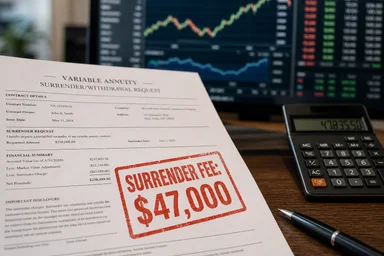
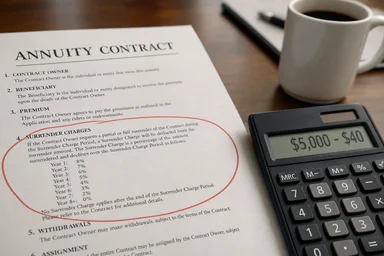
If you're still skeptical, consider this annuity surrender fee story—another example of hidden costs that eat into returns.
The Hidden Cost of Index Fund Convenience
Vanguard Total Stock Market Index Fund (VTSAX) charges 0.04%. But many investors in Vanguard's actively managed funds pay an average of 0.30%, according to the company's fee disclosures. The convenience of a single fund can come with a hidden premium.
Target-date funds are a prime example. A Vanguard Target Retirement 2045 Fund has an expense ratio of 0.08%, but that's on top of the underlying funds' fees—which are already low, but still add up. For a $50,000 balance, the difference between 0.08% and 0.04% is $20 a year. Over 30 years, that's about $600 lost—not huge, but unnecessary.
Many investors also hold higher-fee funds unnecessarily because they haven't reviewed their portfolio in years. A 2022 survey by Vanguard found that the average investor holds funds with an expense ratio of 0.30%, even though lower-cost alternatives exist in the same category.
The convenience of automatic rebalancing and one-click investing can blind you to these costs. But a few hours of research can often cut your fee load by half or more.
How to Calculate Your Personal Fee Damage
The SEC's mutual fund cost calculator is a free tool that lets you input your balance, expense ratio, and time horizon. For a $200,000 portfolio with a 0.14% fee over 20 years, assuming a 7% return, the calculator shows a loss of roughly $4,800.
To get a more accurate picture, add up all your fund holdings. If you have $100,000 in a 0.14% fund and $50,000 in a 0.30% fund, the weighted average expense ratio is 0.19%. Over 30 years, that could cost over $7,000 in lost growth.
You can also use a spreadsheet: multiply each fund's balance by its expense ratio to get the annual fee. Then use a compound interest formula to see how those fees would have grown if invested. The math is straightforward but eye-opening.
A word of caution: don't sell funds just to switch to lower-cost ones if you'll trigger capital gains taxes. In a taxable account, the tax hit might outweigh the fee savings. In a retirement account, though, you can swap freely.
Three Funds That Slash Fees Without Sacrificing Returns
Vanguard S&P 500 ETF (VOO) charges 0.03% and tracks the S&P 500 with near-zero tracking error. Over the past decade, its annual return has matched the index within 0.01%. For investors who want broad U.S. stock exposure, this is hard to beat.
iShares Core U.S. Aggregate Bond ETF (AGG) also charges 0.03%. It tracks the Bloomberg U.S. Aggregate Bond Index, giving exposure to investment-grade bonds. For a bond allocation, this is as cheap as it gets.
Schwab U.S. Broad Market ETF (SCHB) charges 0.03% as well. It covers the entire U.S. stock market, including small- and mid-cap stocks, with a similar track record. All three funds are widely available at most brokerages.
Some investors worry that ultra-low-fee funds might have hidden costs like securities lending. While that's a risk, the revenue from lending often offsets expenses, and these funds' expense ratios are net of those costs. For most, the simplicity and low cost are worth the trade-off.
One Uncomfortable Trade-Off You Must Accept
Ultra-low-fee index funds often exclude a small-cap value tilt, which some research suggests can boost returns over the long term. Factor-based funds that target value, momentum, or size typically charge 0.10% to 0.30% in fees, erasing some of the cost advantage.
For example, the Vanguard Small-Cap Value ETF (VBR) has an expense ratio of 0.07%, still low but double that of VOO. A portfolio that adds a factor tilt might require rebalancing and extra complexity. For many investors, the simplicity of a single total market fund is worth the tiny fee premium.
Critics of the low-fee-only approach argue that a few basis points don't matter if a fund delivers alpha. But the evidence that active managers consistently beat benchmarks is weak. Most factor premiums have also shrunk in recent decades as they became widely known.
Ultimately, the trade-off is between a slightly higher expected return from factors and the certainty of lower costs. For most people, the simpler, cheaper portfolio wins over a long horizon.
Your Next Move: Audit Your Holdings This Weekend
Log into your brokerage account and list every fund you own, along with its expense ratio. You can find this on the fund's fact sheet or your brokerage's research page. Compare each to the lowest-cost alternative in its category, such as a Vanguard or iShares ETF.
Consider tax implications before selling. If you're in a taxable account, you might want to direct new contributions to lower-cost funds instead of selling existing holdings. In a retirement account, you can swap without tax consequences.
Set a calendar reminder to review your fees annually. Fund expenses can change, and new low-cost options appear regularly. A 0.05% difference on a $500,000 portfolio is $250 a year—not life-changing, but worth capturing.
For more on how fees can quietly drain your savings, read this story about annuity surrender fees. It's a stark reminder that costs matter everywhere.
This article is for informational purposes only and does not constitute personalized financial advice. Consult a qualified professional before making investment decisions.
Real-World Examples of Fee Impact
Consider two investors, Alice and Bob. Alice invests $100,000 in a fund with a 0.14% expense ratio, while Bob chooses a fund with 0.03%. Both earn a 7% annual return before fees and contribute an additional $10,000 per year. After 30 years, Alice's portfolio grows to approximately $1,178,000, while Bob's reaches $1,214,000—a difference of $36,000. That's the cost of a 0.11% fee gap.
Now consider a larger portfolio. For a $500,000 initial investment with no additional contributions, the same 0.11% gap results in a $54,000 difference over 30 years. These numbers illustrate that even small percentage differences compound into significant sums.
Another example: a retiree with $1 million in a 0.14% fund withdraws 4% annually. The fee reduces the withdrawal by $1,400 in the first year alone, and the lost growth on that fee compounds over a 30-year retirement, potentially reducing the portfolio's longevity by several years.
These examples show that fee vigilance is not just for large portfolios—every dollar counts. For those with smaller balances, the percentage impact is the same, making it equally important to seek low-cost options.
Counter-Argument: When Higher Fees Might Be Justified
Some investors argue that paying a higher fee is worthwhile if the fund provides access to a unique asset class or strategy. For instance, a fund specializing in venture capital or private equity may charge 1% or more, but it offers diversification that public markets cannot replicate. Similarly, a fund with a strong track record of outperformance might justify its fee, though such persistence is rare.
Another case is when a fund provides significant tax benefits. Municipal bond funds, for example, may have higher expense ratios than taxable bond funds, but the tax-exempt income can offset the fee for investors in high tax brackets. The key is to compare after-tax returns, not just expense ratios.
Additionally, some investors prefer actively managed funds for behavioral reasons—they trust the manager to avoid bubbles or provide downside protection. While the data shows that most active managers underperform, a minority do add value. If an investor has conviction in a particular manager, the extra fee might be acceptable.
However, these exceptions do not apply to the vast majority of investors. For those using broad market index funds, fees are the primary determinant of net returns, and minimizing them is the most reliable path to wealth accumulation.
The Role of Fee Trends in Portfolio Construction
Expense ratios have been declining across the industry due to competition and regulatory pressure. In 2020, the average expense ratio for equity mutual funds was 0.50%, down from 0.99% in 2000. For index equity funds, the average is now 0.06%. This trend benefits investors but also means that older, higher-fee funds should be replaced when possible.
When constructing a portfolio, consider using a core-satellite approach: hold the bulk of assets in ultra-low-cost index funds, and allocate a small portion to higher-fee strategies that you believe can add value. This limits the fee drag while allowing for diversification.
Also, be aware of fee structures in different account types. In a 401(k), you may be limited to a menu of funds with varying fees. If the cheapest option is still 0.30%, consider lobbying your employer to add lower-cost funds, or use an IRA for the bulk of your savings where you have more choices.
Finally, remember that fees are not the only cost. Trading commissions, bid-ask spreads, and taxes also reduce returns. A comprehensive cost analysis includes all these factors, but expense ratios are the most predictable and controllable.
Advanced Fee Calculation: Beyond Simple Averages
To estimate your exact fee drag, use a future value formula: FV = PV * (1 + r - f)^n, where PV is present value, r is the gross return, f is the expense ratio, and n is the number of years. Compare this to FV with f=0 to find the dollar loss.
For multiple funds, calculate the weighted average expense ratio based on each fund's proportion of the total portfolio. Then apply the same formula. This gives a more accurate picture than using a single average.
Consider also the impact of fees on withdrawals. If you withdraw funds periodically, the fee reduces the amount available for withdrawal each year. A spreadsheet that models annual contributions, growth, and fees can provide a detailed projection.
Online tools like the SEC's cost calculator are helpful, but they assume constant returns and fees. In reality, returns vary, and expense ratios can change. For a rough estimate, the calculator is sufficient; for precise planning, use a more sophisticated model.
One last nuance: expense ratios are deducted from dividends and capital gains before they are distributed. This means that in a taxable account, you pay taxes on the lower amount, slightly reducing the tax impact. However, this effect is small and does not offset the fee's drag on growth.