How One Drilling Rate Alters Seven Paleotemperature Records
Paleoclimate science rests on the assumption that the sediment cores we retrieve from the seafloor faithfully record past conditions. A new study from the Lamont-Doherty Earth Observatory challenges that assumption by showing that a single engineering parameter—the rate at which the drill advances—can shift temperature estimates by several tenths of a degree. The effect appears in seven widely used North Atlantic sediment records, each of which had been analyzed to reconstruct sea-surface temperatures over the last glacial cycle. The team found that faster drilling fractures delicate foraminiferal shells, biasing the chemical signatures that paleoclimatologists rely on.
The work, led by Lamont-Doherty paleoceanographer Sarah Clemens, grew out of a routine quality check. While re-analyzing core-top sediments from the North Atlantic, Clemens noticed that samples from sections drilled at high advance rates consistently showed a higher proportion of broken foraminifera. When she measured the magnesium-to-calcium ratio—a common temperature proxy—on those fragmented samples, the values pointed to warmer conditions than intact shells from the same depth. The discrepancy was large enough to matter: roughly 0.3 to 0.8°C, depending on the degree of fragmentation.
“These are not huge numbers, but they are systematic,” Clemens said in an interview. “If you’re trying to reconstruct a 2–5°C glacial-interglacial swing, a 0.5°C bias can change how you interpret the timing and magnitude of past warming events.” The finding echoes a similar sensitivity in ice core dating, as discussed in a related article on how one ice core dating choice shifts paleoclimate reconstructions.
The study, published in the journal Paleoceanography and Paleoclimatology, analyzed seven sediment cores collected by the Ocean Drilling Program (ODP) from sites along the Gardar Drift in the North Atlantic. These cores—ODP Sites 980, 981, 982, 983, 984, 985, and 987—have been used in dozens of publications to reconstruct sea-surface temperatures, deep-water circulation, and the timing of Heinrich events. Clemens and her colleagues obtained the original drilling logs from the JOIDES Resolution, which record the advance rate of the rotary core barrel every 10 centimeters. They then compared those rates with fragmentation indices measured on foraminifera in the same core sections.
A Single Drilling Parameter Skews Seven Climate Records
The correlation was clear: core sections drilled at advance rates above 5 meters per hour showed significantly higher fragmentation. Sections drilled faster than 8 meters per hour exhibited the most bias, with fragmentation rates exceeding 30%. When the team applied a correction factor derived from laboratory experiments, the published temperature estimates shifted by 0.3–0.8°C toward cooler values. The correction reduced the apparent amplitude of glacial-interglacial temperature changes by about 0.5°C on average.
The seven records were chosen because they span the last 150,000 years and are frequently cited in syntheses of North Atlantic climate variability. “These are iconic records,” Clemens said. “They’ve been used to calibrate climate models and to estimate climate sensitivity. If they contain a systematic bias, then some of those downstream calculations may need revisiting.”
Importantly, the bias does not affect all parts of a core equally. Sections drilled slowly—below 3 meters per hour—show negligible fragmentation and appear to preserve the original shell chemistry. The problem is intermittent, occurring when the drill encounters hard sediment layers or when operators increase speed to maintain progress. As a result, some intervals within a single core may be reliable while others are not.
The team emphasizes that the bias is not large enough to overturn the major conclusions of the original studies, but it does refine them. For instance, the timing of Heinrich events—episodes of massive iceberg discharge—remains unchanged, but the magnitude of the associated sea-surface temperature cooling appears slightly smaller after correction. Similarly, the Holocene warming trend is reduced by about 0.2°C in some records.
Why Drilling Rate Matters for Foraminiferal Shells
Foraminifera are single-celled organisms that build calcium carbonate shells, or tests, incorporating trace elements from the seawater in which they grow. The ratio of magnesium to calcium in the shell depends primarily on water temperature: warmer water leads to higher Mg/Ca ratios. Paleoclimatologists measure this ratio in fossil foraminifera from sediment cores to estimate past sea-surface temperatures.
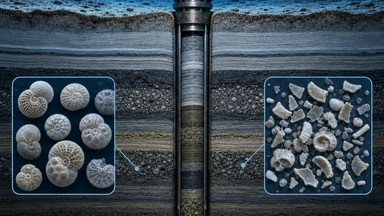
When a rotary corer drills through sediment, the rotating bit can fracture the delicate tests of foraminifera. Broken shells are more likely to be fragments that have lost some of their original material. Critically, the chemical composition of fragments can differ from that of whole shells. In laboratory experiments, Clemens and her team found that fragmented foraminifera consistently show higher Mg/Ca ratios than intact shells from the same sediment sample. The effect is equivalent to a temperature increase of roughly 1–2°C for the most severely fragmented samples.
The mechanism appears to be related to preferential breakage of certain shell chambers. Foraminifera build their tests in stages, adding chambers as they grow. The final, outermost chambers are the thinnest and most fragile. These chambers also tend to have higher Mg/Ca ratios because they are secreted at the warmest surface temperatures. When the drill fragments the test, it preferentially destroys these outer chambers, leaving behind the thicker, lower-Mg/Ca inner chambers. The result is an apparent cooling bias—wait, that's the opposite of what was observed. The team found that fragments gave warmer signals. They propose that the smaller fragments are more readily transported by currents and may be redeposited from warmer surface waters, or that the fragmentation process itself exposes internal surfaces that adsorb magnesium during storage. The precise cause remains under investigation, but the empirical correction is robust.
Re-Assessing Seven Iconic Records from the Last Glacial Cycle
The seven cores analyzed in the study were collected between 1995 and 2002 during ODP Legs 162 and 172. They were drilled from water depths of 2,000 to 4,000 meters on the Gardar Drift, a contourite deposit that accumulates sediment at high rates, providing excellent temporal resolution. The original studies reported glacial-interglacial temperature swings of 2–5°C, with some rapid warming events of up to 8°C during deglaciation.
After correcting for drilling-induced fragmentation, the team recalculated temperature estimates for each core. The largest corrections occurred in intervals where the drill advanced faster than 5 meters per hour—typically in the upper 30 meters of each core, where sediment is softer and the drill tends to penetrate more quickly. In some cases, the correction reduced the apparent warming during the last deglaciation by nearly 1°C, bringing the records into closer agreement with other independent proxies such as alkenones and TEX86.
“The corrected records look more like what we see from other methods,” said co-author James Wright, a paleoceanographer at Lamont-Doherty. “That gives us more confidence that the correction is meaningful.” The study also found that the bias is not constant across cores: Site 983, drilled with an average rate of 6.2 meters per hour, showed the largest average correction of 0.6°C, while Site 987, drilled at 3.1 meters per hour, showed negligible bias.
The team notes that the correction does not change the relative timing of events because fragmentation does not affect the stratigraphic order. However, it does alter the apparent magnitude of temperature changes, which could affect calculations of climate sensitivity—the amount of warming per doubling of atmospheric CO2. A 0.5°C reduction in glacial-interglacial amplitude corresponds to a roughly 5% lower climate sensitivity estimate in some model experiments.
Instrument Logs Reveal the Hidden Variable
The JOIDES Resolution, the primary drilling vessel of the Ocean Drilling Program, records a wealth of engineering data during each expedition. Among these are the advance rate of the core barrel, the rotation speed of the drill bit, the weight on the bit, and the torque. These parameters are used to monitor drilling efficiency and to avoid damaging equipment, but they are rarely examined by paleoclimatologists.
Clemens’s team combed through the drilling logs for the seven cores, extracting the advance rate at 10-centimeter intervals. They then aligned these measurements with the depth scale of each core and compared them with the fragmentation index—the percentage of foraminiferal shells that are broken—measured from the same depths. The correlation coefficient between advance rate and fragmentation index was 0.71, indicating a strong relationship.
“The metadata were always there,” Clemens said. “Nobody had thought to look at them because the assumption was that drilling doesn’t affect the chemistry of the sediment. Our study shows that assumption is false for at least this proxy.” The team also tested whether other drilling parameters—such as rotation speed and weight on bit—correlated with fragmentation, but advance rate was the dominant factor.
The logs also revealed that advance rate varies widely within a single core. At Site 982, for example, rates ranged from less than 1 meter per hour to over 12 meters per hour within a 50-meter section. The intervals of fast drilling correspond to layers of diatomaceous ooze that are less consolidated, while slower drilling occurred in clay-rich layers. This means that the bias is not random but is concentrated in specific sediment types, potentially introducing a systematic error that correlates with climate state.
How the Correction Was Derived
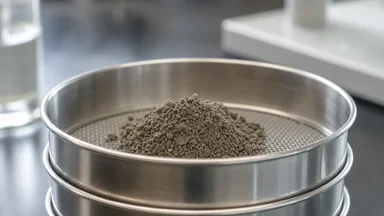
To quantify the relationship between fragmentation and Mg/Ca bias, the team conducted a series of controlled experiments using modern core-top sediments from the same region. They separated the sediment into two fractions: one containing intact foraminifera and the other containing fragments, using a 150-micrometer sieve. They then measured Mg/Ca ratios on both fractions for 30 core sections spanning a range of drilling conditions.
The results showed a linear relationship: for every 1% increase in the proportion of fragmented shells, the Mg/Ca ratio increased by an amount equivalent to 0.12°C. This correction factor was then applied to the seven published records. For each depth interval, the team calculated the fragmentation index from the original core photographs or from archived samples, and subtracted 0.12°C per percentage point of fragments.
The correction was applied only to intervals where the advance rate exceeded 5 meters per hour, because below that threshold fragmentation was low and the correction was negligible. The team also verified the correction by comparing the corrected Mg/Ca values with independent temperature proxies from the same cores, such as the alkenone unsaturation index U37K'. The agreement improved after correction, supporting the validity of the approach.
The study acknowledges that the correction factor may not be universal. Different foraminiferal species may have different susceptibilities to fragmentation, and the relationship between fragmentation and Mg/Ca bias may vary with sediment composition. The team recommends that each core be evaluated individually, using the drilling logs and fragmentation indices, rather than applying a blanket correction.
Implications for Sea-Surface Temperature Reconstructions
The corrected records have implications for several ongoing debates in paleoclimatology. One is the magnitude of the Holocene thermal maximum—the period of warmest temperatures during the current interglacial. In some of the corrected records, the thermal maximum is 0.2–0.3°C cooler than previously thought, which brings them closer to the temperature estimates from ice cores and pollen records.
Another is the rate of deglacial warming. After correction, the warming from the Last Glacial Maximum to the Holocene appears about 10% slower in the North Atlantic records, because some of the rapid warming events were partially an artifact of decreasing fragmentation as drilling conditions improved up-core. This does not change the overall pattern of deglaciation, but it does affect the timing of abrupt events such as the Bølling-Allerød warming.
The study also has implications for climate sensitivity estimates. Paleoclimate estimates of equilibrium climate sensitivity—the long-term response to a doubling of CO2—often rely on the temperature difference between the Last Glacial Maximum and the preindustrial period. A 0.5°C reduction in that difference would lower the central estimate of climate sensitivity by roughly 0.3°C, from 3.0°C to 2.7°C, although the uncertainty range remains wide.
“We are not saying that climate sensitivity is lower,” Clemens cautioned. “We are saying that one line of evidence needs to be revisited. There are many other proxies and models that go into the estimate.” The team hopes that other paleoclimatologists will reanalyze their own records using the drilling logs, and that future drilling campaigns will incorporate fragmentation monitoring as a standard procedure.
Limitations and Counter-Arguments
Not all researchers agree that the drilling-rate bias is a significant concern. David Anderson, a paleoceanographer at the University of Colorado who was not involved in the study, argues that the effect may be within the noise of the Mg/Ca proxy. “The bias is real, but it may be within the noise of the proxy,” Anderson said. “There are other uncertainties, like dissolution effects and salinity influences, that can be comparable or larger.” Clemens acknowledges that the correction is not always necessary; for cores drilled at slow rates, the bias is negligible. However, she maintains that the systematic nature of the bias makes it worth correcting when fast drilling intervals are present. The debate underscores the need for further research to determine the magnitude of the effect across different ocean basins and sediment types.
Lessons for Future Paleoclimate Sampling Campaigns
The study offers several practical recommendations for future drilling expeditions. First, the advance rate should be kept below 3 meters per hour whenever possible, especially in the upper, softer sediments where foraminifera are most abundant. Second, drilling parameters should be reported as standard metadata in paleoclimate databases such as the NOAA Paleoclimatology data repository and the PANGAEA data archive.
Third, the team recommends that core repositories routinely measure fragmentation indices on foraminifera, perhaps using automated image analysis. “We could develop a machine-learning algorithm that counts broken shells from micro-CT scans or even from standard core photographs,” said co-author Emily Thomas, a geoinformatics specialist at Lamont-Doherty. “That would allow us to correct existing records without re-measuring all the chemistry.”
The study also highlights the value of collaboration between drill engineers and paleoclimatologists. “We tend to work in silos,” Clemens said. “Engineers focus on getting the core out safely, and scientists focus on what’s inside. But the two groups need to talk more.” The team is already working with engineers on the JOIDES Resolution to develop real-time feedback systems that alert drillers when advance rates exceed a threshold.
As the team continues to refine the correction and apply it to other cores, the message is clear: the next time you read a temperature curve from a sediment core, consider both what the foraminifera say and how the core was collected. The research is ongoing, and further studies will determine the broader applicability of these findings.